ChatGPT, Claude, Gemini — they all do the same thing: you ask, they answer. Yes, they have optional memory features and can carry context to some extent, but they can’t touch your real world: they can’t open your files, run a command, or take action on your behalf. As I mentioned in my previous article, they are ultimately still advanced tools operating within the boundaries of a chat window — AI Agents.
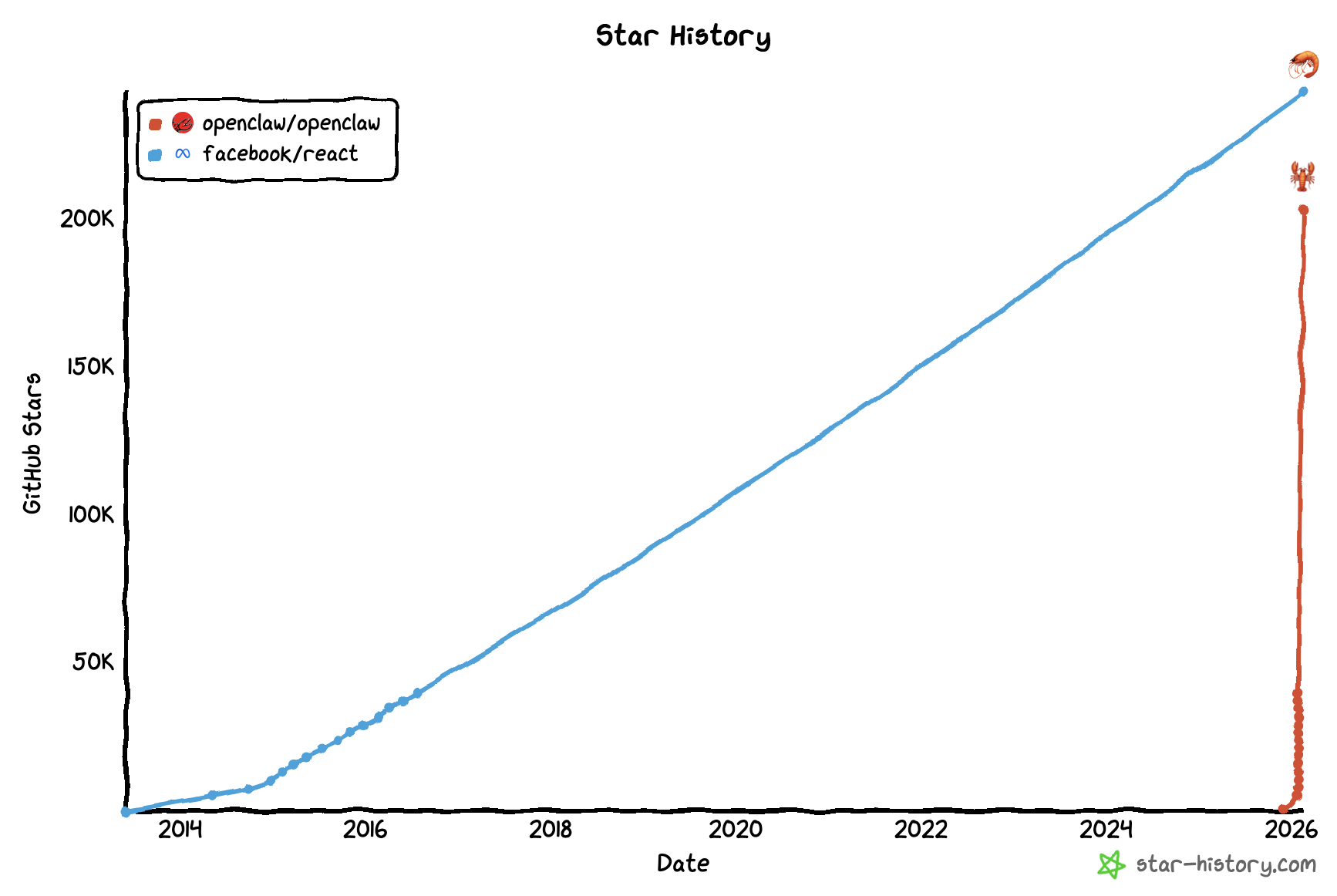
OpenClaw changes this fundamentally. As of February 18, 2026, this open-source project has gathered 203,000 GitHub stars in just 3 months. It’s not a chatbot; it’s an autonomous agent that lives on your computer. It accesses your files, runs terminal commands, browses the web, and most critically: it can take action without you asking repeatedly.
From Chatbot to Agent: Three Evolutions
1. Chatbot: You Ask, It Answers
A question-answer loop. No memory, no context, you explain everything from scratch every next time.
2. AI Assistant: Context Yes, Action No
It follows long conversations, writes code, performs analysis. But it’s still waiting for your command. Everything it does stays within the boundaries of that chat window.
3. Autonomous Agent: Give the Goal, Let It Find the Way
This is where OpenClaw stands. A system that runs on your computer, interacts with its environment, and can make its own decisions. You’re not talking to a chatbot; you’re giving a job to an agent.
Three Things That Make OpenClaw Different
Writing Code and Managing Files from WhatsApp
You can manage files on your computer, write code, and run scripts by sending a message from WhatsApp or Telegram. No need to open an IDE, no SSH. You say “merge the CSVs in that folder and generate a report” from your phone, and OpenClaw does it. This means AI stepping out of the chat window and into the real world.
“Heartbeat”: An Agent That Works Without Being Asked
Traditional assistants only act and respond when you speak. OpenClaw’s heartbeat system makes it proactive. The cronjob that system administrators use to manage their servers is now being used to bring your AI agent to life every 30 minutes. You say “monitor my inbox, if an urgent email comes in, alert me via WhatsApp” — it does it. You say “track trending topics on X, if there’s something related to my field, report what’s being said and message me” — it does that too. A digital assistant standing guard in the background. The clearest indicator of the transition from chatbot to agent: you’re not asking, it’s informing you.
A System That Writes Its Own Skills
When you want OpenClaw to do a new task, it can write the skill to do that task itself. There are hundreds of skills written by the community, but the real power lies here: you can tell the system “learn how to do this” and it writes the necessary code and adds it to its own skill repertoire. Self-improving software — it’s becoming real; this concept is no longer science fiction.
But Is Everything Rosy?
OpenClaw’s promise is big, but it has two important blind spots.
First: The privacy paradox. OpenClaw’s biggest selling point is “it runs on your computer, your data stays with you.” But LLM models you can run locally (Llama, Mistral, etc. via Ollama) are not yet at a level to unlock OpenClaw’s full potential. For real performance, you still need Claude or GPT APIs. So while saying “keep your data on your own computer,” every query you make goes to a cloud server. Local models are improving rapidly, but as of today, a fully self-hosted experience is still a dream.
Second: The founder’s departure. Peter Steinberger, the creator of OpenClaw, joined OpenAI in February 2026 and handed the project over to an open-source foundation. In some eyes, a risk signal. But dozens of OpenClaw forks have already come to life. This is the beauty of open source — the project doesn’t depend on a single person. Just as Linux could live without Linus, OpenClaw will continue to evolve without Steinberger.
The Real Question
OpenClaw is not perfect. The setup is technical, local model support is immature, and security risks must be taken seriously.
But the paradigm shift it represents cannot be ignored. The trio of open source + self-hosted + self-improving gives hope that AI can move out of commercial companies’ walled gardens and into your control. 203,000 developers have voted for this.
The chatbot era is closing, the autonomous agent era is beginning. So what do you think the world will look like when this transition is complete? Will everyone have a chatbot in their pocket and an AI agent on their desk?